2011 Legend
Tom Patton
Montana Bureau of Mines and Geology, Montana Tech
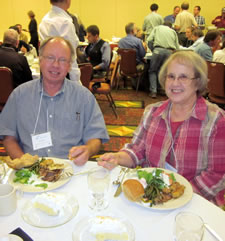 2011 Water Legend Tom Patton with his wife, Mary, at the conference banquet
As the 2011 Water Legend, Tom Patton was acknowledged for the 38 year career he has had in service to Montana, its people and its water. Tom has been active in AWRA for more than15 years – during that time he has given 10 presentations (in 2008 he was invited to give a plenary presentation) and he has served as moderator on at least two occasions. Additionally, he has encouraged (required) his staff to present the results of their work at AWRA and to serve as board members.
Left: 2011 Water Legend Tom Patton with his wife, Mary, at the conference banquet
Tom received a bachelor’s degree in geography and geology from Valparaiso University in 1973. He received a Master of Science Degree in Geology from the Montana College of Mineral Science and Technology (now Montana Tech of The University of Montana) in 1987. He worked at DNRC from 1974-78. Then he took a position with the Montana Bureau of Mines and Geology and is currently a Senior Research Hydrogeologist. In addition, Tom has worked on many ground-water resource evaluations in areas such as the Turner-Hogeland Plateau, the Burton Bench north of Choteau, and at Giant Springs in Great Falls. He is also actively researching methods to identify and isolate climate signals in long-term groundwater hydrographs. Tom has authored or co-authored more than 80 publications and has made more than 200 presentations; he is a nationally recognized expert on groundwater monitoring and groundwater data management.
In regards to state water policy development, Tom has worked with legislators and presented to legislative committees regarding groundwater, groundwater monitoring data needs, and groundwater data storage. In conjunction with the legislature, DNRC, Bureau staffers, and well drillers he proposed changes in statute that, when adopted by the Legislature, allowed Montana to accept electronically filed water-well logs. This new method has made it easier for drillers to file, and more efficient for agency personnel to review the logs, AND it ensures that the data are entered into the Ground Water Information Center. Tom has been a long-term member of the Montana Drought Advisory Task Force’s technical advisory committee.
However, it is in program development where Tom has made his mark and will leave an incredible legacy to future water professionals, researchers, regulators, and ordinary citizens who want to drill a well. Starting in the late 1980’s Tom was instrumental in the planning and development of what would become the Montana Ground Water Assessment Program (GWAP). The Legislature established the program in 1991 and Tom has been the program leader since 1996 and oversees a staff of nine professionals and several students. The program is devoted to systematically evaluating the groundwater resources of the state and includes three sub programs:
-
The Ground Water Monitoring program – which now includes a network of more than 900 wells around the state to produce long-term water level and water-quality data,
-
The Ground Water Characterization program – which provides regional-scale evaluations of the hydrogeology and water quality of the state’s major aquifers, and
-
The Ground Water Information Center (GWIC) database – which makes all manner of groundwater data available.
This program provides readily accessible backbone data and knowledge that are necessary to address the state’s water issues. Tom has been heavily involved in every aspect of the planning, development and execution of this program and has worked closely with Tribes, local water quality districts, and other agencies to link with and/or obtain their data (water levels and aquifer tests from DNRC and DEQ).
In addition to the meeting the state’s need for water information, Tom has also devoted increasing effort representing GWAP to other Federal agencies, and national groups. He has developed a program in conjunction with Natural Resources Conservation Service to provide technical hydrogeologic assessments for cost-share wells. He worked with the U.S. Forest Service to develop groundwater assessment and inventory methodologies for Forest Service lands. Recently he has been assisting the Federal Advisory Committee for Water Information’s Subcommittee on Groundwater, a national working group tasked with developing a systematic approach to monitoring the nation’s groundwater resources. Montana was selected to participate in pilot program for the national monitoring network because of its advanced groundwater monitoring network and database. Tom’s expertise and experience has been influential in writing several sections of the national framework document proposing establishing a National Ground Water Monitoring Network.
Tom is the consummate professional. He has worked with or provided data to: high school science fair students, individuals looking to buy some land, ranchers, well drillers, realtors, consultants, college and graduate students, professors, agency scientists (state and federal), tribal scientists, legislators, watershed groups, conservation districts, news reporters, and his colleagues at the Bureau. His knowledge and reputation among his peers, other agency personnel, and well drillers is unmatched. He is a person of great integrity and generous with his time. He plays first trumpet in the Butte Symphony and volunteers his time giving lessons with the Butte Young Musicians Club.
